
EUROPEAN VINTAGE EMPORIUM
US Furniture Export Compliance System
Internal working procedure — September 2026
Purpose
This procedure is used whenever EVE intends to sell or export a vintage, antique, used or refurbished furniture item to a customer in the United States.
The objective is to:
- identify CPSC requirements that may apply;
- prevent the sale of recalled or unsafe furniture;
- identify items requiring specialist review;
- determine whether certification and/or CPSC eFiling may apply;
- maintain an auditable record of the decision.
This procedure is designed for individual vintage and antique items, not mass-produced new furniture.
Important: This is an internal compliance screening procedure, not legal advice. Where an item falls into a regulated or uncertain category, EVE should obtain advice from its US customs broker, CPSC compliance specialist or other qualified professional before export.
PART 1 — THE EVE DECISION TREE
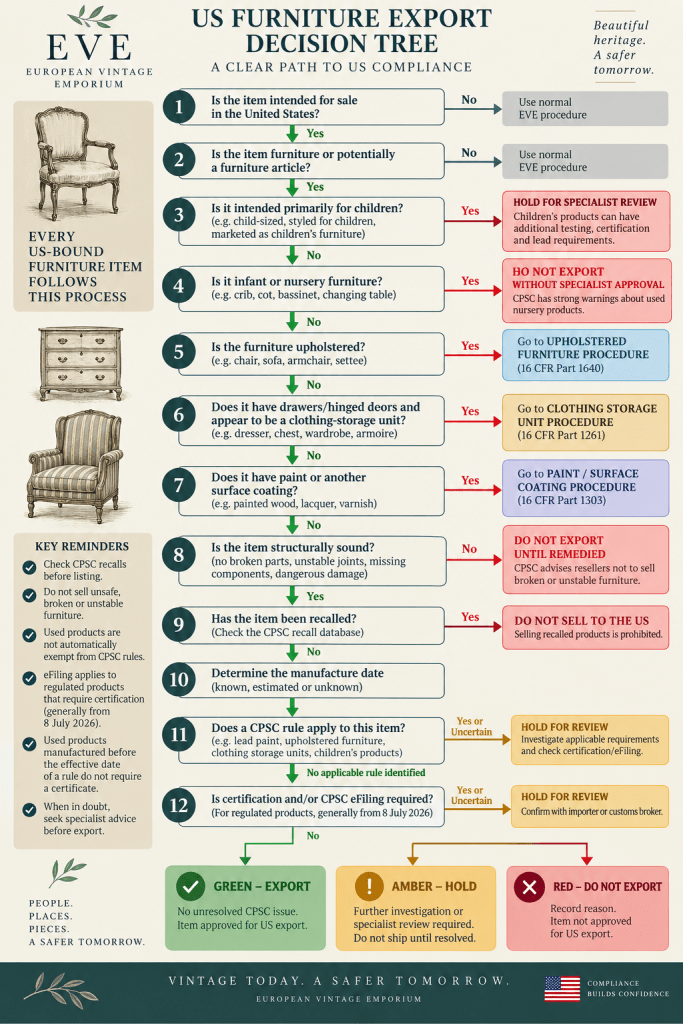
STEP 1 — Is the item intended for sale in the United States?
NO
→ Normal EVE procedure.
YES
→ Continue to Step 2.
STEP 2 — Is the item furniture or potentially a furniture article?
Examples:
- table
- desk
- chair
- cabinet
- bookcase
- dresser
- chest
- wardrobe
- bureau
- sideboard
- shelving
- stool
- bench
- sofa
- armchair
- settee
- other movable household furniture
YES
→ Continue.
If the item’s classification is unclear:
→ AMBER — REVIEW
STEP 3 — Is it intended primarily for children?
Ask:
- Is it specifically designed for children?
- Is it child-sized?
- Is it decorated or styled specifically for children?
- Is it marketed as children’s furniture?
- Is its principal intended use by children aged 12 or under?
YES
→ RED — HOLD FOR SPECIALIST REVIEW
Children’s products can have additional testing, certification, tracking and lead requirements.
Do not treat a children’s item as ordinary vintage furniture merely because it is antique.
NO
→ Continue.
STEP 4 — Is it infant or nursery furniture?
Examples:
- crib/cot
- bassinet
- changing table
- children’s bed
- other durable infant/toddler furniture
YES
→ RED — DO NOT EXPORT WITHOUT SPECIALIST APPROVAL
CPSC gives particularly strong warnings regarding used nursery products and specifically advises resellers not to sell broken or unstable nursery furniture or durable infant products missing parts.
NO
→ Continue.
STEP 5 — Is the furniture upholstered?
Examples:
- upholstered chair
- armchair
- sofa
- settee
- upholstered stool
- upholstered bench
- upholstered seating furniture
YES
→ Go to UPHOLSTERED FURNITURE PROCEDURE.
NO
→ Continue.
STEP 6 — Does the item have drawers and/or hinged doors and appear to be clothing-storage furniture?
Potential examples:
- dresser
- chest of drawers
- wardrobe
- armoire
- bureau
- chifferobe
- door chest
YES
→ Go to CLOTHING STORAGE UNIT PROCEDURE.
NO
→ Continue.
STEP 7 — Does the furniture have paint or another surface coating?
Examples:
- painted wood
- painted metal
- lacquer
- coated surfaces
- painted furniture with a decorative finish
YES
→ Go to PAINT / SURFACE COATING PROCEDURE.
NO
→ Continue.
STEP 8 — Is the furniture structurally sound?
Inspect for:
- broken legs
- loose joints
- missing structural components
- cracked frames
- unstable bases
- dangerously loose drawers
- damaged hinges
- unsafe glass
- sharp or dangerous protrusions
- evidence of previous structural failure
NO
→ RED — DO NOT EXPORT UNTIL REMEDIED
CPSC advises resellers not to sell broken, cracked or unstable furniture.
YES
→ Continue.
STEP 9 — Has the item been recalled?
Search the CPSC recall database before listing/export.
YES
→ RED — DO NOT SELL TO THE US
NO
→ Continue.
STEP 10 — Determine the item’s manufacture date
Record:
Known date: __________
or
Estimated date: __________
or
Unknown: __________
Where possible, retain evidence supporting the date:
- manufacturer’s mark
- label
- construction method
- provenance
- original documentation
- catalogue evidence
- expert assessment
- photographs
- known design period
Do not invent a precise manufacturing date when only an approximate date is supportable.
STEP 11 — Determine whether a CPSC rule actually applies
If no applicable CPSC rule, ban or standard has been identified:
→ GREEN — PROCEED
If a rule may apply:
→ AMBER — REVIEW
If a rule definitely applies and EVE cannot establish compliance:
→ RED — HOLD / DO NOT EXPORT
STEP 12 — Determine certification/eFiling requirements
If the item is subject to a CPSC certification requirement:
- determine who is the responsible importer;
- determine who will provide the required certificate;
- determine whether the shipment requires CPSC eFiling;
- obtain confirmation from the customs broker/importer where necessary.
For imported regulated products, CPSC’s eFiling requirements generally apply from 8 July 2026. However, CPSC states that used products manufactured before the effective date of an applicable CPSC rule do not require a certificate and therefore eFiling does not apply to those products. Used regulated products manufactured after the effective date can require certification/eFiling when commercially imported.
EVE TRAFFIC-LIGHT SYSTEM
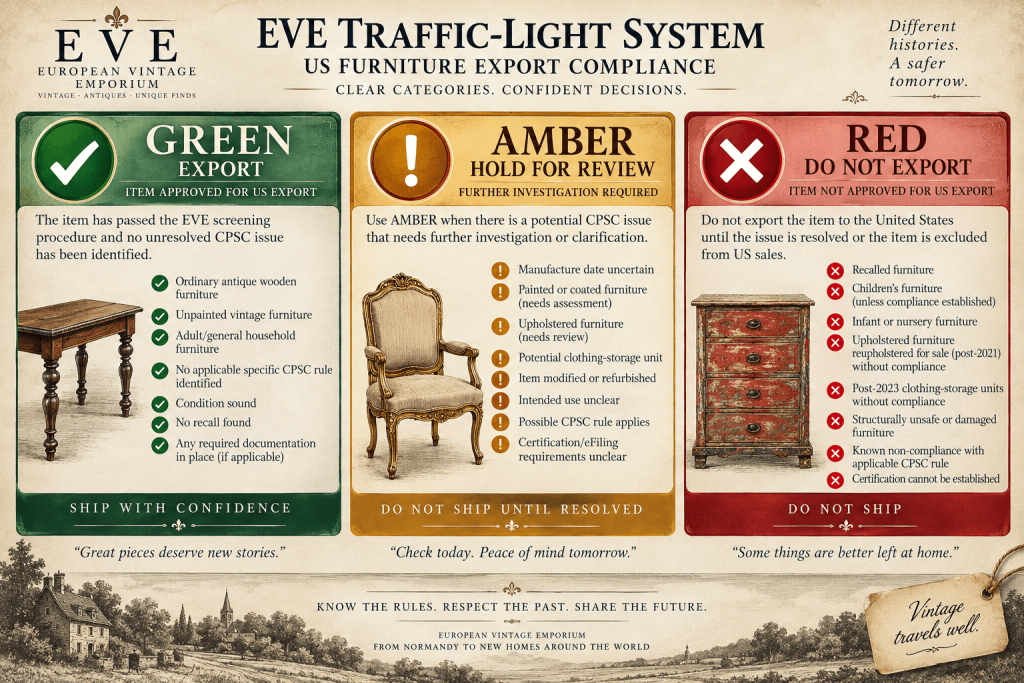
GREEN — EXPORT
The item has passed the EVE screening procedure and no unresolved CPSC issue has been identified.
Examples may include:
- ordinary antique wooden table;
- antique desk;
- ordinary bookcase;
- unpainted vintage cabinet;
- ordinary adult furniture with no applicable specific rule;
- historic furniture outside the effective date of a particular modern rule.
GREEN does not mean “CPSC exempt in every respect.”
It means:
EVE has completed its screening and has no unresolved US compliance issue.
AMBER — HOLD FOR REVIEW
Use AMBER when:
- the manufacture date is uncertain;
- a CPSC rule may apply;
- the item is painted/coated and its regulatory status requires investigation;
- the item is upholstered;
- the item is a potentially qualifying clothing-storage unit;
- the item has been modified or refurbished;
- the intended use is unclear;
- the item’s classification is uncertain;
- certification responsibility is unclear.
Do not ship an AMBER item until the issue is resolved.
RED — DO NOT EXPORT
Use RED when:
- the item is recalled;
- the item is unsafe or structurally unsound;
- the item is an infant product requiring specialist compliance that EVE cannot establish;
- the item is children’s furniture and compliance cannot be established;
- required certification cannot be established;
- an applicable mandatory requirement is not met;
- required upholstered-furniture compliance cannot be established;
- the item has a known prohibited safety defect.
PART 2 — PAINT AND SURFACE COATINGS
16 CFR Part 1303
Movable furniture articles bearing lead-containing paint or similar surface coatings fall within the federal lead-paint regulation.
CPSC identifies furniture such as beds, bookcases, chairs, chests, tables and dressers among the furniture articles covered.
EVE procedure
Record:
Surface finish: __________________
Painted/coated: YES / NO
Known manufacture date: __________________
Evidence: __________________
Important reseller point
CPSC’s reseller guidance says resellers are not generally required to test furniture themselves, but they must not knowingly sell non-compliant painted furniture. CPSC recommends checking recalls and exercising appropriate care where there is reason to suspect excessive lead.
EVE rule
Do not automatically reject antique painted furniture.
Instead:
- establish approximate age;
- identify whether the item falls within the relevant regulation;
- check recalls;
- assess whether there is reason to suspect a prohibited coating;
- escalate where necessary.
Testing
Where testing is genuinely warranted for a valuable item, EVE should use an appropriate professional method rather than relying on cheap consumer lead-testing kits. CPSC’s reseller guidance notes that commercially available lead-testing kits can be unreliable and identifies XRF screening as one possible approach.
PART 3 — CLOTHING STORAGE UNITS
16 CFR Part 1261
The federal clothing-storage-unit standard applies to qualifying units manufactured after 1 September 2023.
A clothing-storage unit generally has:
- drawers and/or hinged doors;
- free-standing construction;
- height of at least 27 inches;
- mass of at least 30 lb;
- enclosed storage volume of at least 3.2 cubic feet;
- an intended clothing-storage function typical of bedroom furniture.
Examples include:
- dressers;
- chests of drawers;
- drawer chests;
- armoires;
- chifferobes;
- bureaus;
- door chests;
- wardrobes.
Important exclusions
CPSC identifies various products outside the CSU scope, including:
- bookcases;
- entertainment furniture;
- office furniture;
- dining furniture;
- jewelry armoires;
- under-bed drawer storage;
- occasional/accent furniture not intended for bedroom use;
- permanently installed built-in units.
EVE procedure
If the item appears to be a CSU:
Manufactured before 2 September 2023
→ Record the manufacture date/evidence.
→ Continue the general safety and recall checks.
Manufactured after 1 September 2023
→ AMBER/RED — specialist review
The current rule applies based on the product’s manufacture date, not simply the date it enters the United States.
PART 4 — UPHOLSTERED FURNITURE
16 CFR Part 1640
This is one of EVE’s most important specialist categories.
The federal upholstered-furniture flammability requirements apply to covered furniture manufactured, imported or reupholstered on or after 25 June 2021. The standard incorporates TB 117-2013.
The permanent-label requirement applies to furniture manufactured, imported or reupholstered on or after 25 June 2022.
Critical EVE rule
CPSC explicitly states that reupholstered furniture, including antiques, must comply when reupholstered for sale.
Therefore:
Antique chair — original upholstery
→ AMBER
Investigate.
Antique chair — reupholstered for EVE sale
→ RED / HOLD
Compliance must be established before US export.
Antique sofa — recently reupholstered
→ RED / HOLD
Upholstered furniture with the required compliance label and supporting evidence
→ AMBER → GREEN once verified
Important certification distinction
A GCC is not required solely to demonstrate compliance with 16 CFR Part 1640.
Instead, applicable upholstered furniture must have the required permanent certification label.
CPSC specifies the statement:
“Complies with U.S. CPSC requirements for upholstered furniture flammability.”
The item may nevertheless have other requirements — such as lead or children’s-product requirements — that separately trigger certification.
PART 5 — CHILDREN’S FURNITURE
Children’s furniture requires a separate compliance assessment.
Potential issues include:
- lead;
- children’s-product testing;
- certification;
- tracking information;
- product-specific mandatory standards;
- recalls.
EVE policy
Do not process children’s furniture through the ordinary Green pathway.
Classify:
RED — SPECIALIST REVIEW
until the exact product, intended age group and applicable requirements have been established.
PART 6 — INFANT / NURSERY PRODUCTS
Examples:
- cribs/cots;
- bassinets;
- infant beds;
- changing tables;
- other durable infant/toddler products.
EVE policy
RED — DO NOT EXPORT WITHOUT SPECIALIST APPROVAL
CPSC specifically warns resellers against selling broken or wobbly nursery furniture or durable infant products with missing parts, even where the item has not been recalled.
For practical purposes, EVE should strongly consider a blanket policy of not exporting these categories to the US unless there is a specific commercial reason and compliance can be independently established.
PART 7 — RECALL CHECK
Every US-bound furniture item receives a recall check.
Check before listing
Search:
CPSC recalls
Search using:
- manufacturer;
- brand;
- model;
- product name;
- identifying number;
- distinctive design;
- relevant keywords.
CPSC specifically instructs resellers to check its recall database before selling used products.
Result
No relevant recall found
→ Continue.
Potential match
→ AMBER.
Investigate identity.
Confirmed recall
→ RED — DO NOT SELL TO US
Selling products subject to applicable recalls is prohibited.
PART 8 — CONDITION INSPECTION
Before approval, physically inspect the item.
Structural
☐ Legs secure
☐ Frame secure
☐ Joints sound
☐ No significant cracks
☐ No dangerous instability
☐ No missing structural components
Moving parts
☐ Drawers operate safely
☐ Doors operate safely
☐ Hinges secure
☐ No dangerous pinch points identified
Surfaces
☐ No dangerous flaking finish
☐ No exposed sharp edges
☐ No dangerous protrusions
Glass/mirrors
☐ Secure
☐ No dangerous cracks
☐ No unstable mounting
Furniture-specific
☐ Stability acceptable
☐ Tip-over risk considered
☐ No obvious unsafe modification
Result
PASS / FAIL / REVIEW
CPSC recommends that resellers do not sell broken, cracked or unstable furniture.
PART 9 — EVE US EXPORT RECORD
CPSC references
Primary sources to retain with this procedure:
- CPSC — eFiling FAQ
- CPSC — Certificates and eFiling
- CPSC — Resale/Thrift Store guidance
- CPSC — Resellers Guide to Selling Safer Products
- CPSC — Upholstered Furniture, 16 CFR Part 1640
- CPSC — Clothing Storage Units, 16 CFR Part 1261
- CPSC — General Use Products: Certification and Testing
These should be treated as the controlling references; this EVE document is the operational screening procedure built from them.