
How to Identify Vintage Furniture: A Beginner’s Guide
A practical guide to recognising age, style, materials and craftsmanship
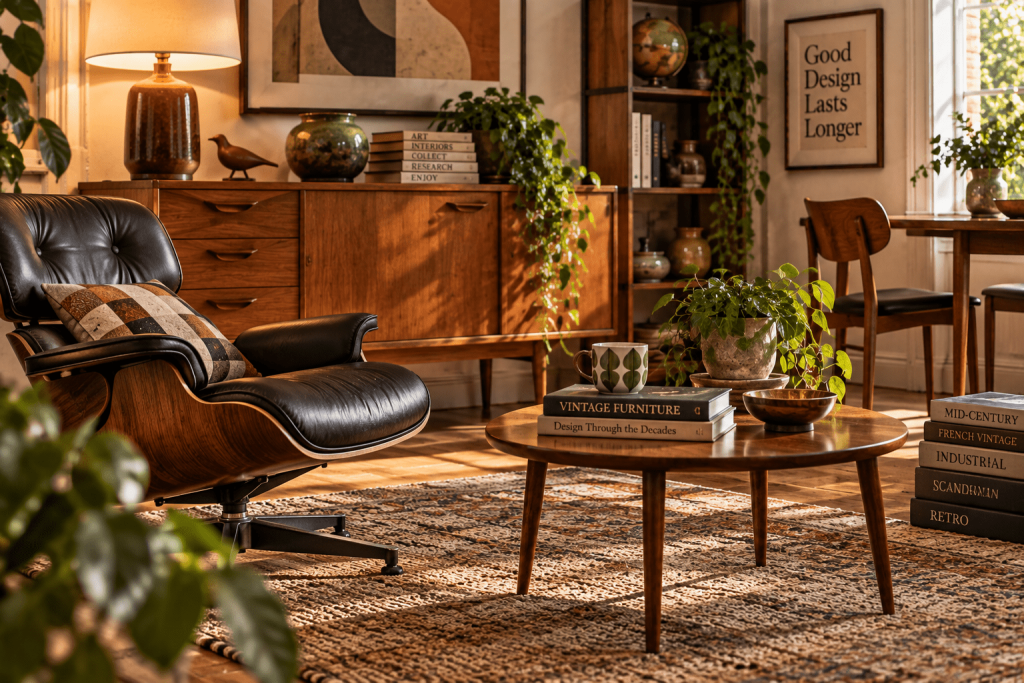
Vintage furniture can be surprisingly difficult to identify.
At first glance, something may simply look old.
Perhaps it has a beautiful wooden frame, a faded finish, a set of interesting handles or a distinctly mid-century shape. Maybe it has been sitting in someone’s home for fifty years. Perhaps it came from a hotel, a school, an office or a family home.
But is it actually vintage?
And if it is, what period does it come from?
Was it made in the 1950s, 1960s, 1970s or 1980s? Was it mass-produced or made by a smaller manufacturer? Is the material original? Has it been altered? And how much of what you are seeing is actually original to the piece?
The good news is that you don’t need to be an expert to start answering these questions.
Just as with antique furniture, the trick is to look beyond the surface.
With vintage furniture, however, there are some different clues to look for.
Let’s have a proper look.
Quick Answer: How Do You Identify Vintage Furniture?
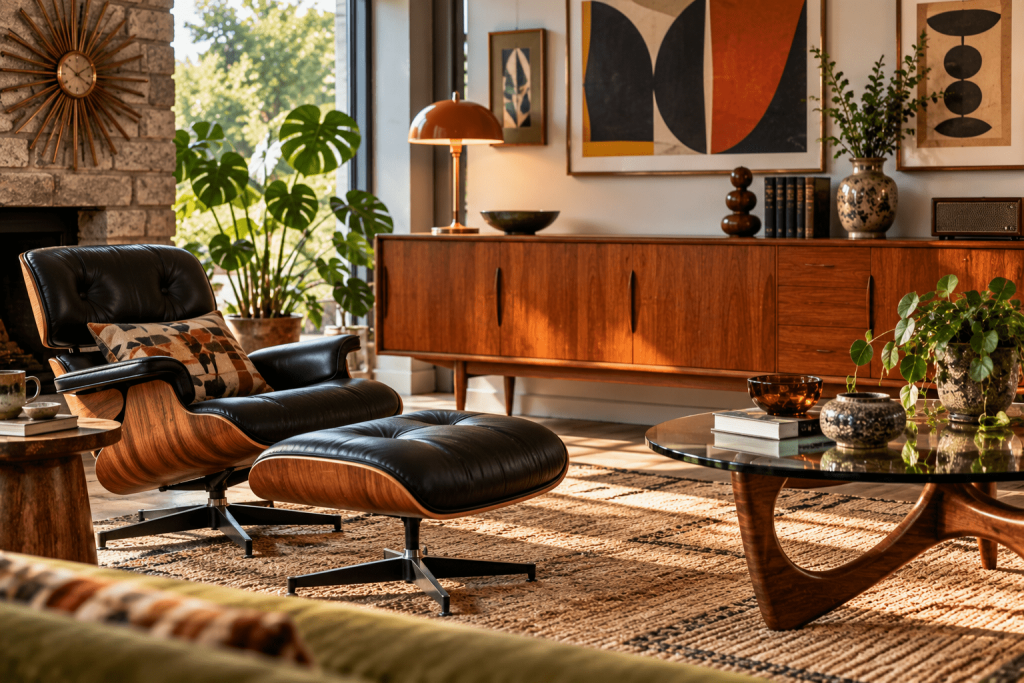
The best way to identify vintage furniture is to consider several clues together rather than relying on its appearance or a single feature.
Start by looking at:
- the overall design and shape
- the materials used
- how the furniture was constructed
- screws, fixings and joinery
- veneers, laminates and manufactured boards
- upholstery and fabrics
- handles, hinges and other hardware
- labels, stamps and manufacturer’s marks
- proportions and design details
- signs of wear and genuine age
- repairs, replacements and alterations
- whether all the different clues fit the same period
Vintage furniture can be particularly tricky because it was often produced using increasingly sophisticated machinery and industrial manufacturing techniques.
A piece can therefore be relatively young while still looking remarkably well made.
Likewise, something can look convincingly vintage because it copies the design of an earlier period.
The important question isn’t simply:
“Does this look old?”
It is:
“Does the way this piece was made make sense for the period it is supposed to come from?”
That is where things get interesting.
Start With the Overall Design
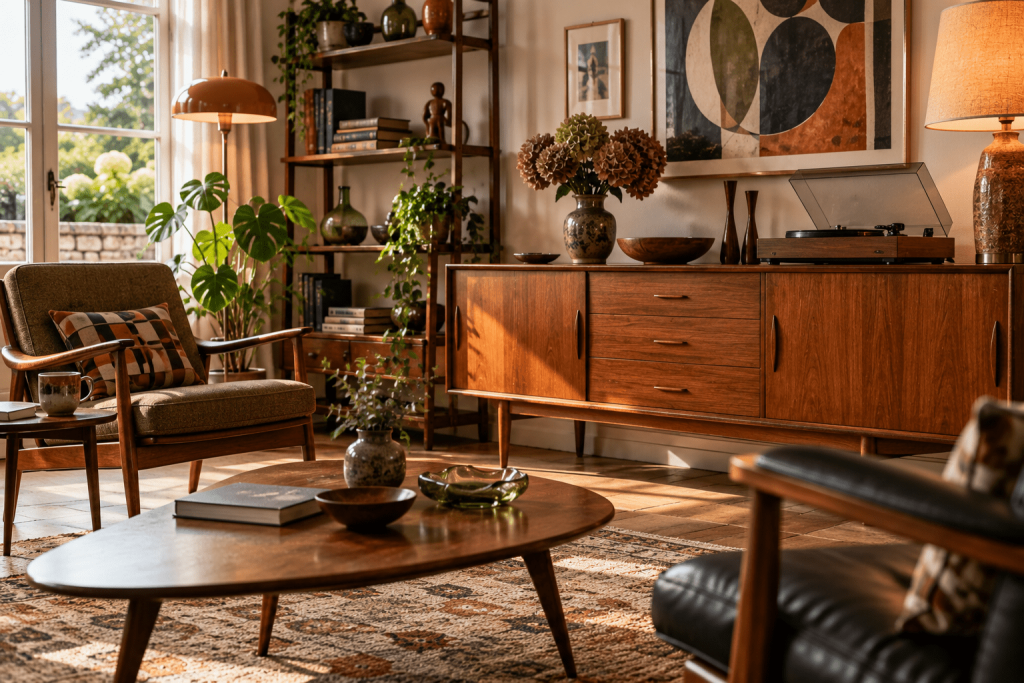
Before examining screws, labels or materials, simply look at the furniture.
What does it actually look like?
Is it a sideboard, coffee table, dining chair, chest of drawers, bookcase, desk, cabinet, dressing table or armchair?
Then look at its overall shape.
Is it angular or curved?
Light and delicate or heavy and substantial?
Highly decorated or deliberately simple?
Does it have tapered legs, splayed legs, turned legs, hairpin legs or a pedestal base?
Are the edges sharp and geometric, or rounded and flowing?
Vintage furniture often has a very strong visual language.
A 1950s piece might have elegant tapered legs and organic curves.
A 1960s design might introduce stronger geometric shapes, moulded plastics or striking colour combinations.
The 1970s brought plenty of darker woods, chunky forms, chrome, glass and bold upholstery.
By the 1980s, furniture could become considerably more dramatic, with polished surfaces, strong geometric forms, laminate, glass and metal appearing in all sorts of combinations.
These are broad tendencies, not rules.
And that distinction matters.
A designer in 1972 didn’t receive a memo saying, “Right, everyone must now stop making anything that looks like the 1960s.”
Furniture styles overlap.
Look at How It Was Made
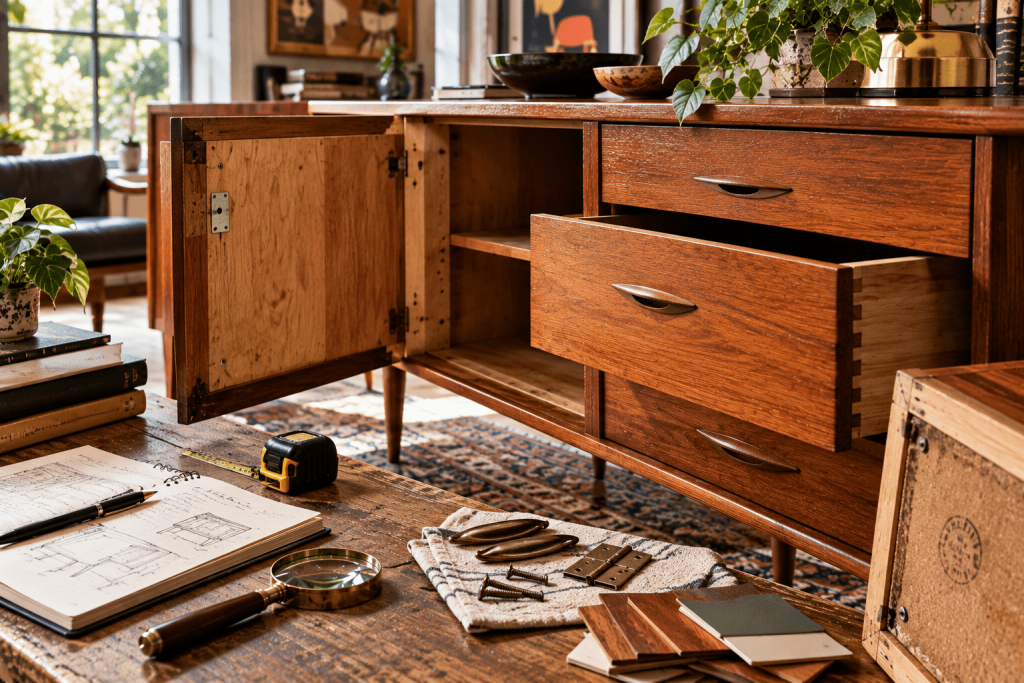
With vintage furniture, construction can be an extremely useful clue.
The post-war period saw enormous changes in furniture manufacturing.
Machinery became increasingly sophisticated. Factory production expanded. New materials became affordable. Screws, fittings, adhesives, veneers, laminates and manufactured boards became widely available.
This means that the construction methods used in a piece can sometimes tell you considerably more than its appearance.
Look underneath.
Look behind.
Open drawers.
Check the inside of cupboards.
Look at how legs attach to the body.
Examine the underside of tables and chairs.
Don’t be afraid to turn something over.
Furniture has a surprisingly unglamorous underside.
And sometimes that’s where it tells the truth.
Materials Can Be a Big Clue
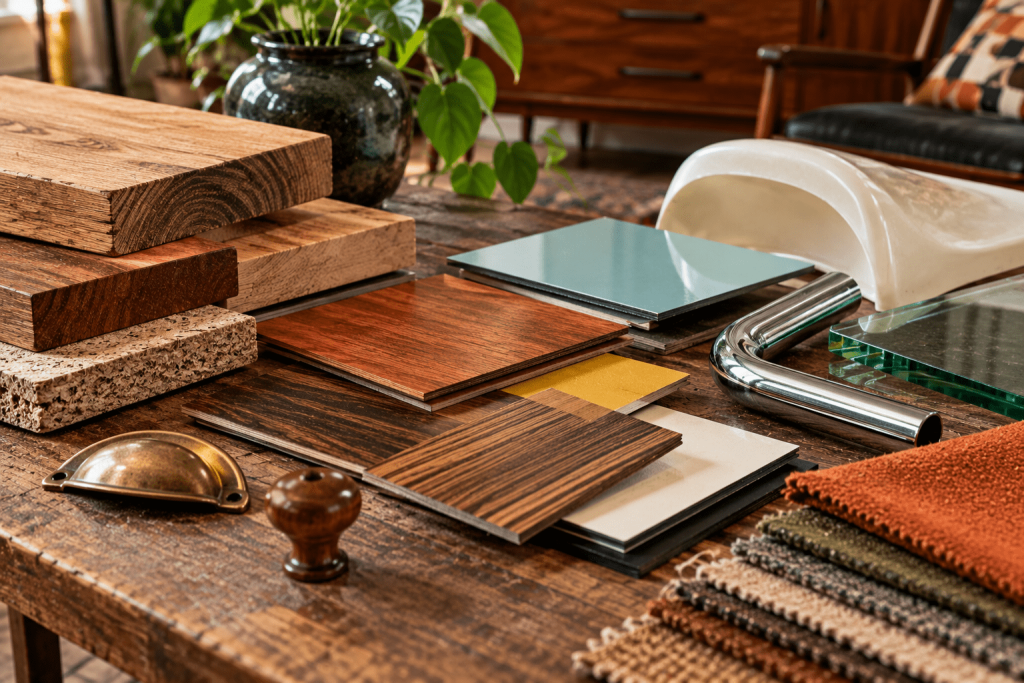
One of the biggest differences between identifying antique and vintage furniture is the range of materials you may encounter.
Of course, traditional woods continued to be used.
Oak, walnut, teak, mahogany, beech, ash, elm, pine and many other timbers appear throughout vintage furniture.
But the twentieth century also brought a much wider use of:
- plywood
- veneered boards
- chipboard
- hardboard
- laminates
- plastics
- Perspex and acrylics
- chrome
- tubular steel
- aluminium
- glass
- synthetic fabrics
- foam
The material itself can therefore provide an important clue.
For example, a piece incorporating moulded plastic and chrome is going to tell you a very different story from a solid oak farmhouse table.
But again, one material doesn’t automatically give you an exact date.
Furniture designers experimented.
Manufacturers copied successful ideas.
Older pieces were sometimes updated.
New pieces were sometimes deliberately made to look traditional.
Think of materials as evidence, not a verdict.
Veneer Tells You Something
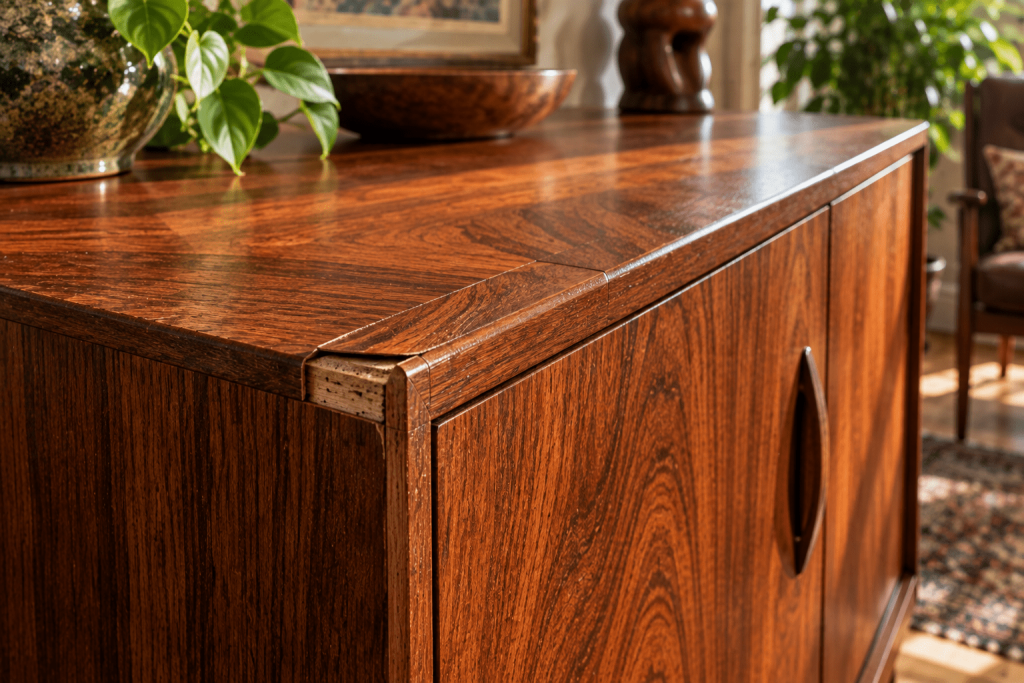
Veneer deserves particular attention.
Vintage furniture often makes extensive use of veneers, allowing manufacturers and designers to create beautiful surfaces without constructing the entire piece from expensive solid timber.
A veneered cabinet can be extremely well made.
There is no reason to regard veneer as inferior simply because it isn’t solid wood.
Look closely at the edges.
Can you see where the veneer finishes?
Is the grain direction consistent with the construction?
Are there joins?
Does the veneer appear original?
Has it lifted or been repaired?
Has someone replaced part of it?
Older veneer can develop its own character, including changes in colour, small losses, bubbling or repairs.
A well-made veneered piece can be a wonderful example of twentieth-century craftsmanship.
Don’t Be Frightened of Manufactured Boards
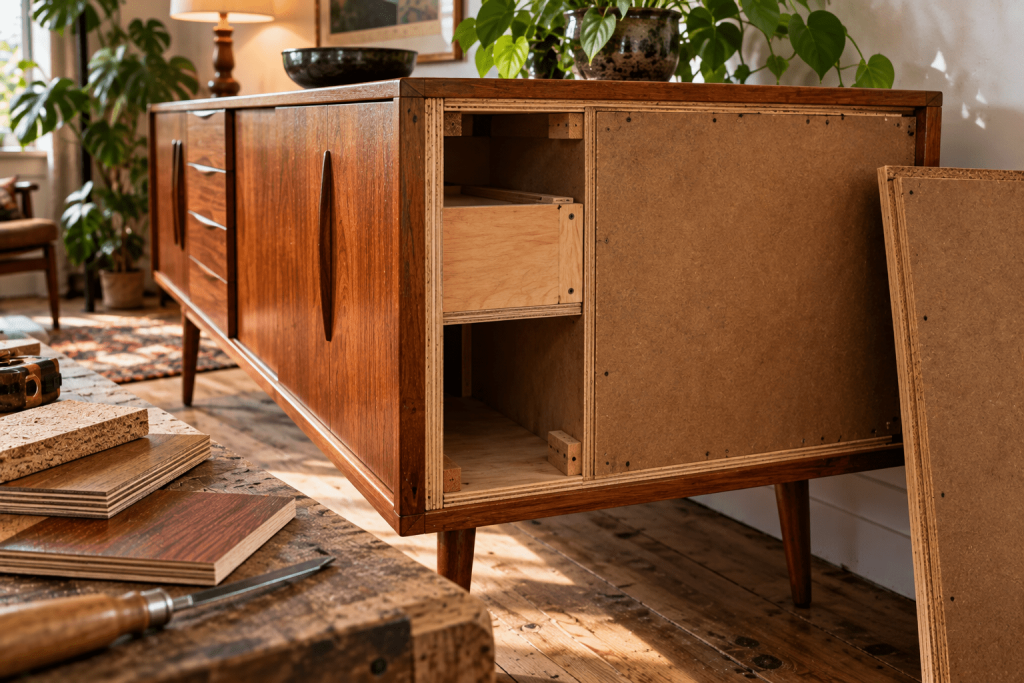
This is another area where beginners sometimes make a mistake.
Finding plywood, hardboard or another manufactured board doesn’t automatically mean you’ve found a modern piece.
These materials have been used in furniture for a very long time.
The important thing is how they were used and what other evidence surrounds them.
A vintage cabinet might combine a veneered front, plywood components, solid timber edging and a manufactured-board back.
That combination can tell you a great deal about how the furniture was designed and manufactured.
The construction needs to make sense as a whole.
Look at the Joinery
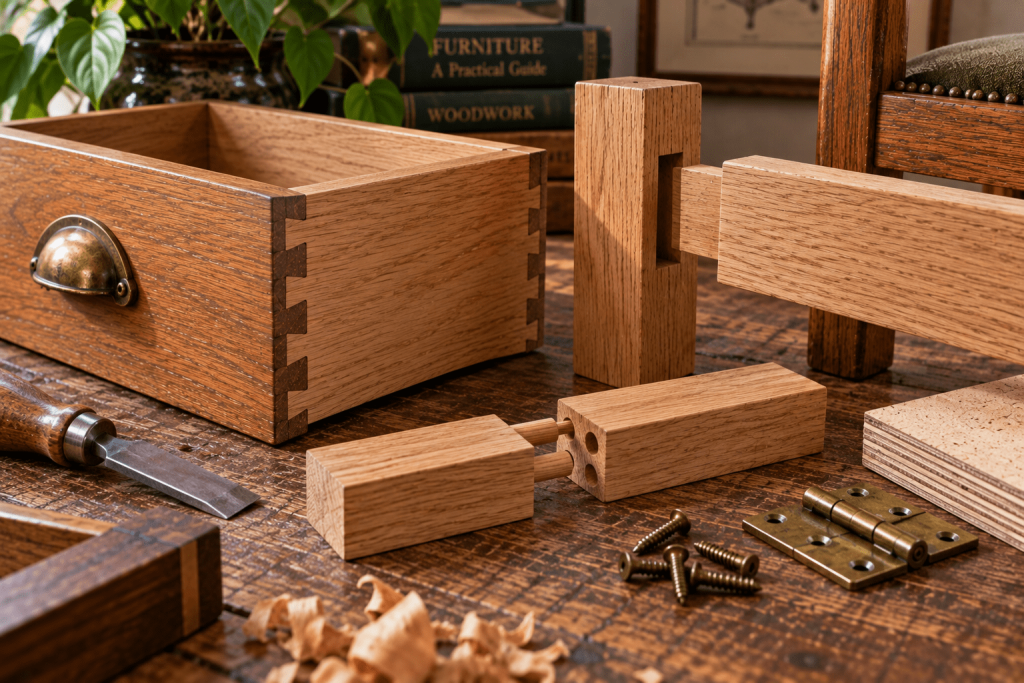
Traditional dovetails still exist in vintage furniture, but you should not expect every vintage drawer to look like an eighteenth-century cabinetmaker made it by hand.
Machine production changed everything.
Look at the consistency of the joints.
Are they very regular?
Are the cuts extremely precise?
Are there visible machine-made grooves?
Are screws or dowels used extensively?
How are the drawer sides attached to the front?
How is the cabinet assembled?
None of these clues should be treated as an instant date stamp.
Instead, ask yourself:
“Does this construction method fit the period and type of furniture I’m looking at?”
That is a much more useful question.
The Drawer Test Still Works — But Differently
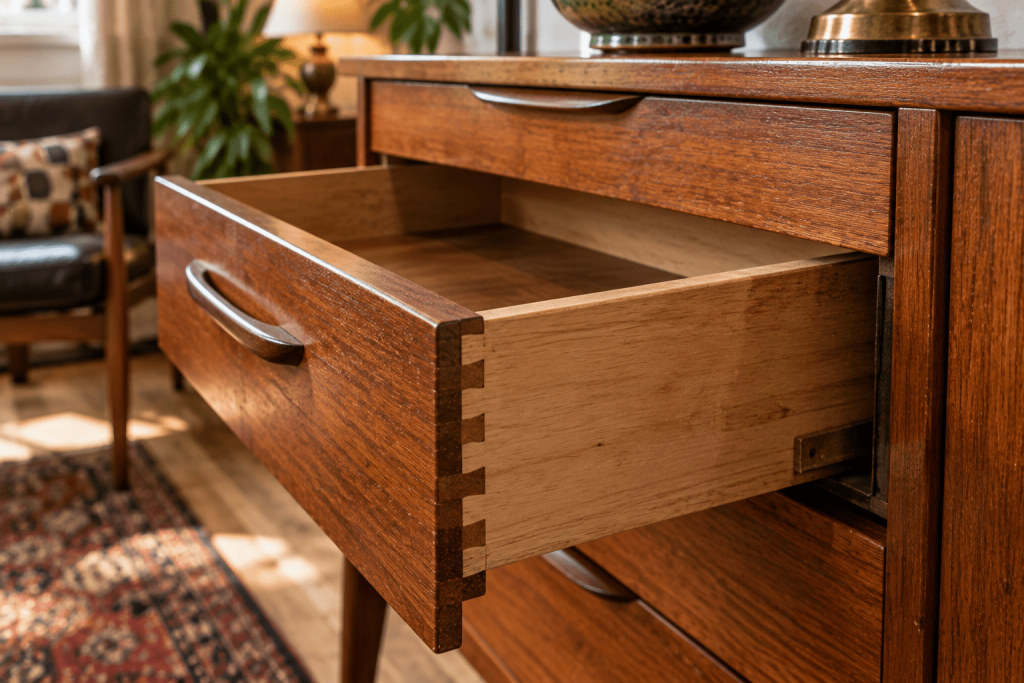
Drawers remain one of the best places to investigate furniture.
Pull one out.
Look at the sides.
Look underneath.
Look at the back.
Look at how the drawer bottom is fitted.
Look at the joint between the front and the sides.
With vintage furniture, machine-cut dovetails may be extremely neat and regular.
That doesn’t make them suspicious.
In fact, that regularity may be exactly what you should expect from a factory-produced piece.
The trick is understanding the manufacturing context.
A 1960s factory-made chest of drawers isn’t supposed to look like an eighteenth-century hand-made commode.
That’s not a weakness.
It’s part of its history.
Hardware Can Help Date the Furniture
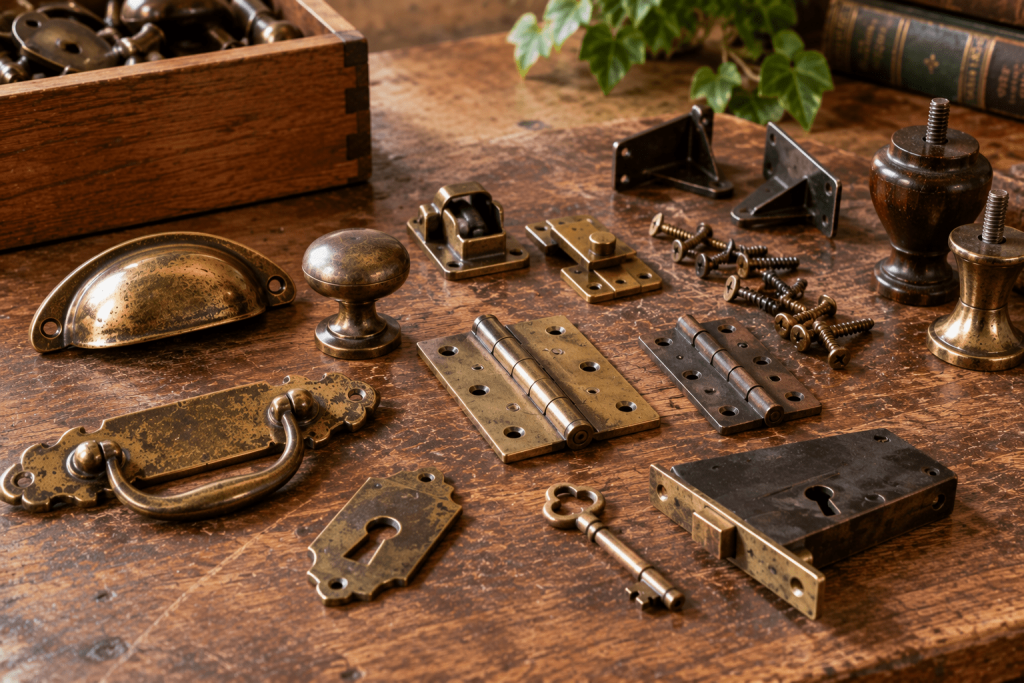
Handles, hinges, catches, locks, brackets and feet can all provide useful clues.
Look closely at them.
Are they original?
Do the holes match the hardware?
Is there evidence that handles have been replaced?
Are there extra holes underneath?
Does the wear around the hardware correspond with years of use?
Screws can also be interesting.
Modern screws in an otherwise older piece might indicate later repairs.
But the opposite can also be true: original vintage furniture can contain very modern-looking fixings because screw manufacturing had already become highly developed.
Don’t fall into the trap of thinking:
“Old screw = old furniture.”
It doesn’t work that neatly.
Instead, look at the complete construction.
Labels and Manufacturer’s Marks Are Gold
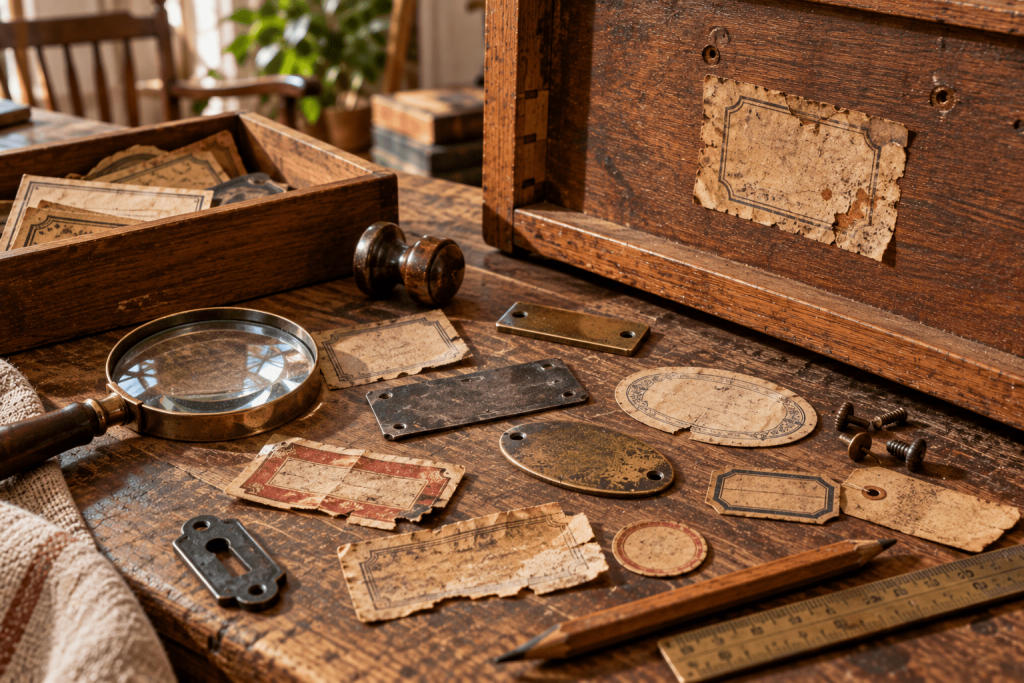
Vintage furniture has one enormous advantage over many older pieces:
there is a much greater chance that someone left a paper trail.
Manufacturers increasingly used labels, stamps, stickers, metal plaques and printed marks.
Look underneath.
Look inside cupboards.
Check the backs of drawers.
Look at the underside.
Check behind removable panels where appropriate.
You may find:
- a manufacturer’s label
- a model number
- a serial number
- a retailer’s label
- a country-of-origin mark
- a designer’s name
- a patent number
- a production sticker
- a handwritten owner’s note
A label can sometimes transform an identification from a guess into a much more informed conclusion.
But even labels need to be treated carefully.
They can be damaged, removed, replaced or copied.
A manufacturer’s name is a clue worth investigating, not an excuse to stop investigating.
Country of Origin Can Matter
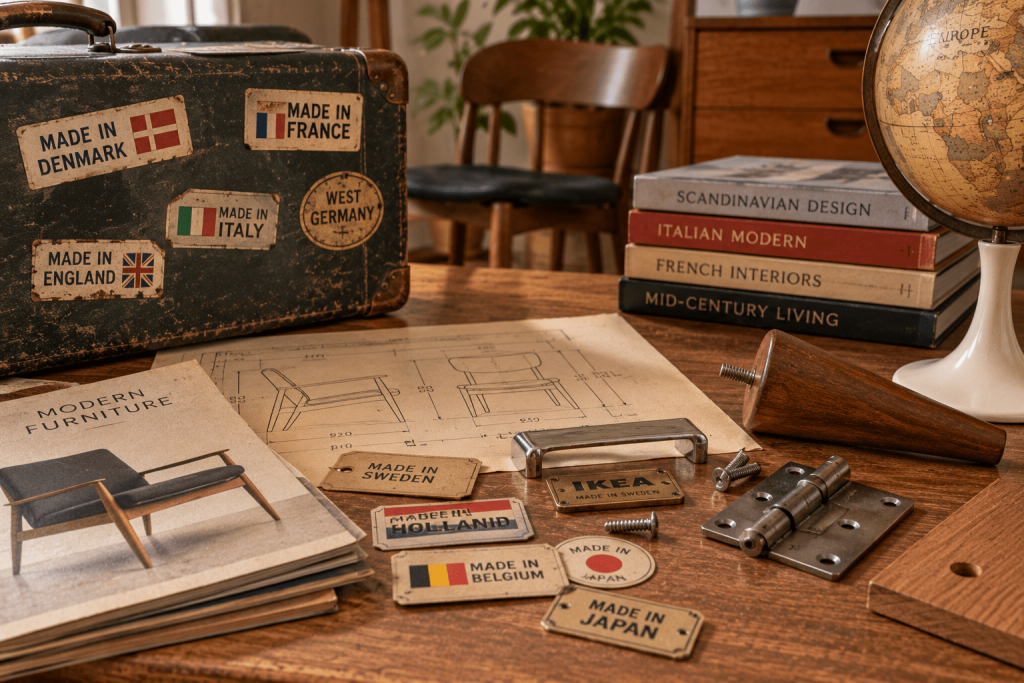
Where a piece was made can also help.
British, French, Scandinavian, Italian, American and other furniture manufacturers developed their own traditions, materials and manufacturing methods.
Some styles travelled internationally and were copied widely.
Others are much more strongly associated with particular countries or manufacturers.
If you can establish where something was made, you may suddenly have a much smaller field of possibilities.
Look for country-of-origin labels, manufacturer’s marks, construction details and distinctive materials.
And remember that furniture was exported.
A piece being found in France doesn’t necessarily mean it was made in France.
A Scandinavian design might have been manufactured elsewhere.
The object may have travelled considerably further than its original maker ever expected.
Style Is Important — But Don’t Let It Fool You
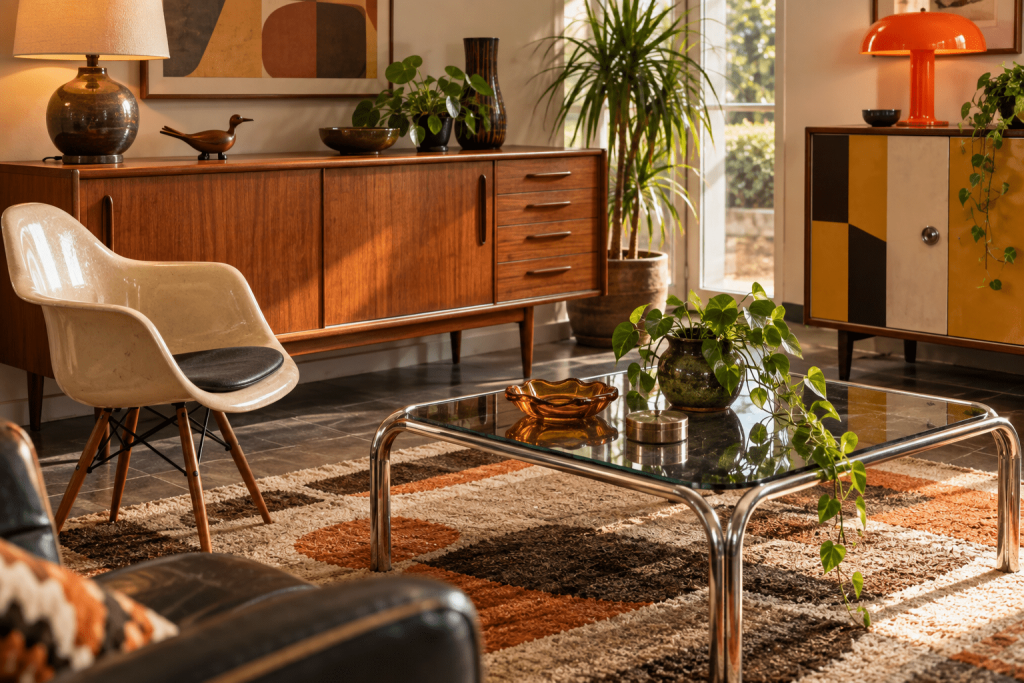
Style is one of the most obvious ways to identify vintage furniture.
It is also one of the easiest ways to get it wrong.
Mid-century modern is a good example.
The term covers an enormous range of furniture, designers, manufacturers and countries.
Not everything with tapered legs is automatically “mid-century.”
Not every teak cabinet is Scandinavian.
Not every curved chair is from the 1950s.
And not every piece with a 1970s colour palette was actually made in the 1970s.
Style should always be tested against construction, materials and other physical evidence.
If the style says one thing but the construction says something completely different, stop and investigate.
That disagreement may be the most interesting clue you’ve found.
Learn to Recognise the Broad Decades
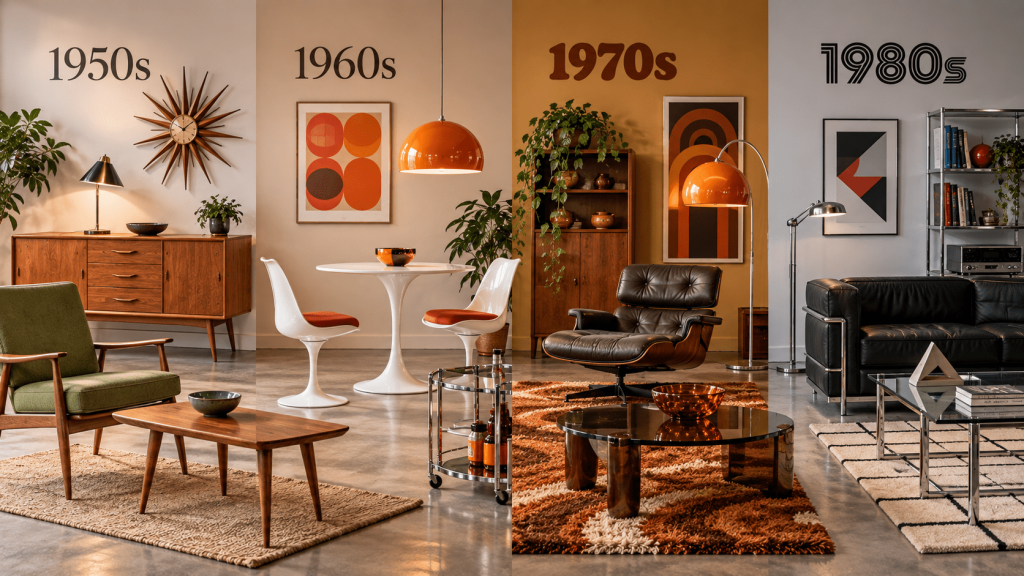
You don’t need to memorise every designer and manufacturer to start identifying vintage furniture.
It can be useful to develop a broad feeling for the decades.
1950s
Look for lighter, optimistic forms.
Tapered legs, organic curves, simple silhouettes, light woods, colourful upholstery and restrained decoration are common themes.
There is often a sense of post-war modernism and practical design.
1960s
Furniture becomes more adventurous.
You may encounter stronger geometric forms, sculptural shapes, richer colours, moulded materials, chrome and increasingly experimental designs.
Plastic becomes particularly interesting.
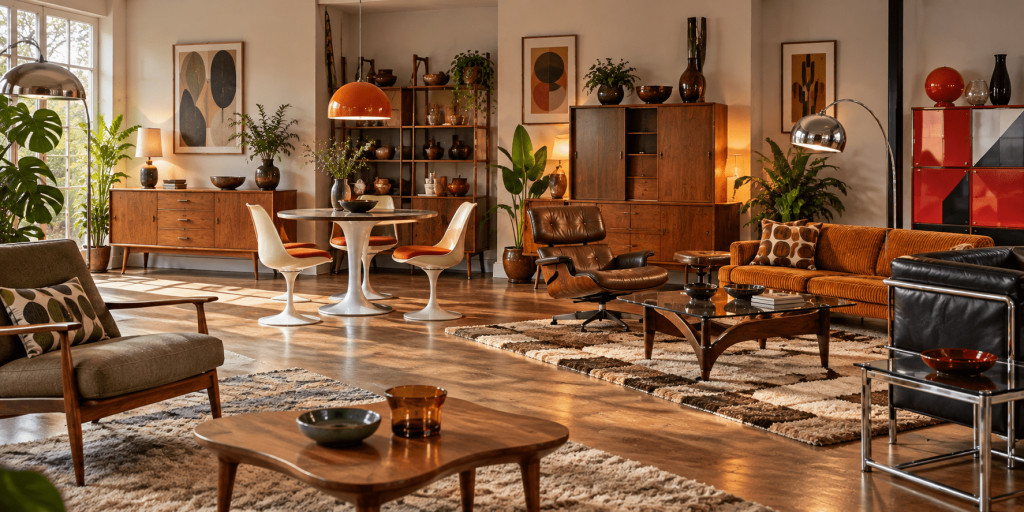
1970s
Think warmer and heavier.
Dark woods, substantial forms, chrome, glass, textured fabrics, bold upholstery and earthy colours appear frequently.
But don’t reduce the decade to brown furniture.
There was plenty of experimentation too.
1980s
Design becomes increasingly bold and sometimes theatrical.
Laminates, glass, polished finishes, metal, strong geometric shapes and striking contrasts become more common.
Some furniture is highly decorative.
Some is minimalist.
Some is simply gloriously over the top.
And that, frankly, is part of the fun.
Proportions Still Matter
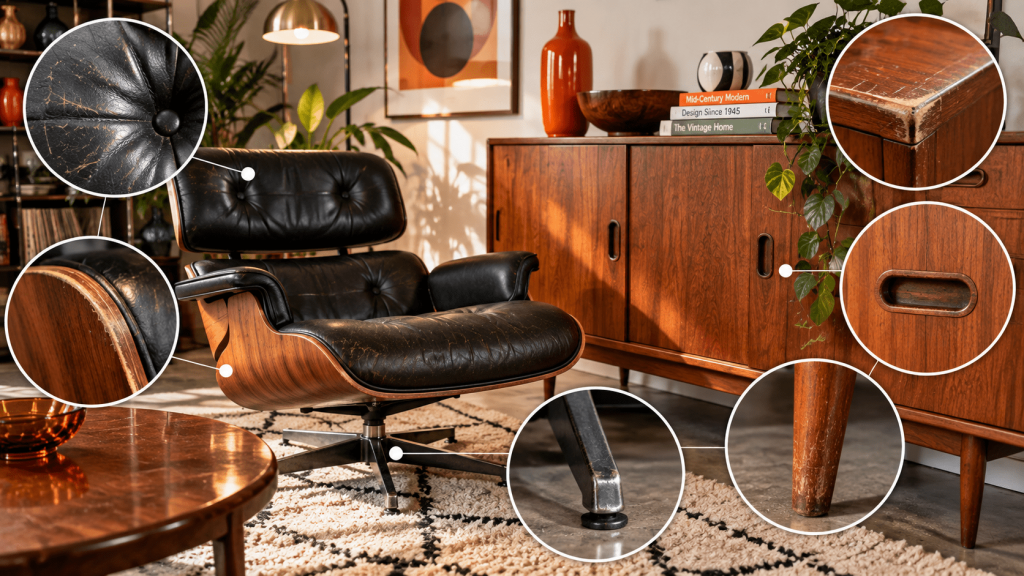
Just as with antique furniture, proportions can be a surprisingly useful clue.
Look at the height, width and depth.
Look at the relationship between the legs and the body.
Look at the size of drawers.
Look at the thickness of components.
Look at the size of handles.
Look at how much visual space the piece occupies.
Furniture from different periods often has different ideas about what looks balanced.
Once you begin looking at enough examples, you start noticing when something feels slightly wrong.
Perhaps the legs are too chunky.
Perhaps the cabinet is unusually deep.
Perhaps the handles are strangely large.
Perhaps the proportions feel more contemporary than the supposed date suggests.
You don’t need to know exactly why something looks wrong immediately.
That feeling is often enough to make you investigate further.
Upholstery Can Tell You a Story
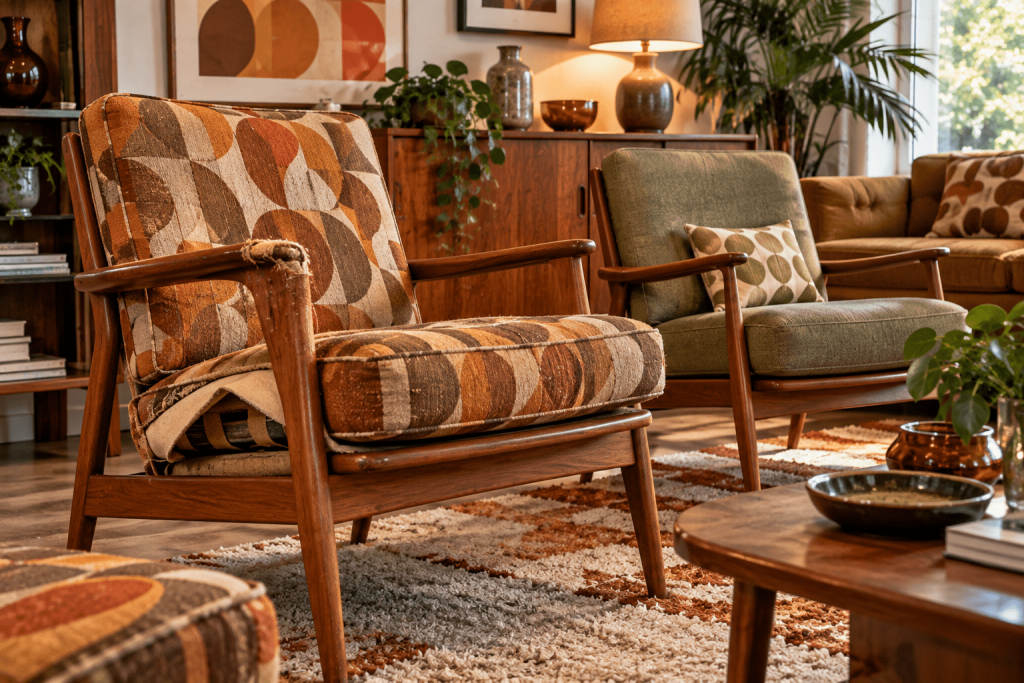
Don’t ignore the fabric.
On chairs, armchairs and sofas, upholstery can provide useful information about age and alteration.
Look at the fabric itself.
Is it original?
Does the pattern fit the period?
Has the piece been re-covered?
Is there an older fabric underneath?
What type of foam, padding or filling has been used?
Has the upholstery been replaced recently?
A beautifully preserved vintage chair may have had several different coverings during its lifetime.
That doesn’t make the chair less interesting.
It simply means you need to distinguish between the age of the frame and the age of the upholstery.
This is particularly important when buying vintage seating.
Look at the Feet
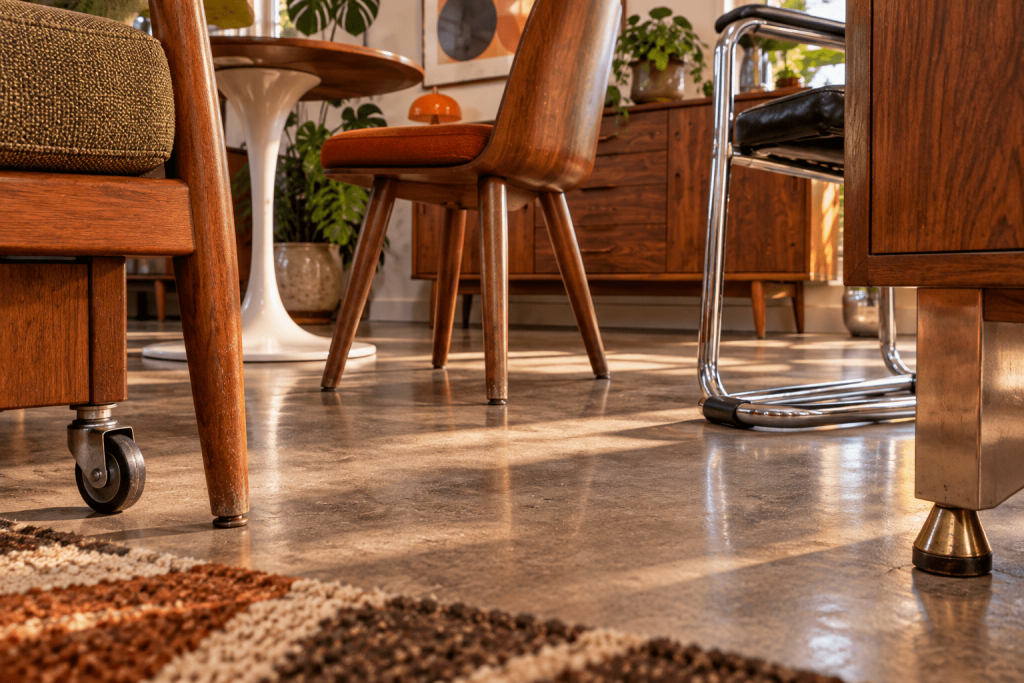
Furniture feet can be wonderfully revealing.
They are also easy to overlook.
Look at the shape.
Look at how they attach to the furniture.
Look at the material.
Look at the finish.
Look at the wear.
Are the feet original?
Have they been replaced?
Do all four match?
Is there evidence that the furniture once had casters or a different base?
Sometimes a change in feet can completely alter the apparent character of a piece.
And sometimes the feet tell you exactly what you needed to know.
What About Patina?
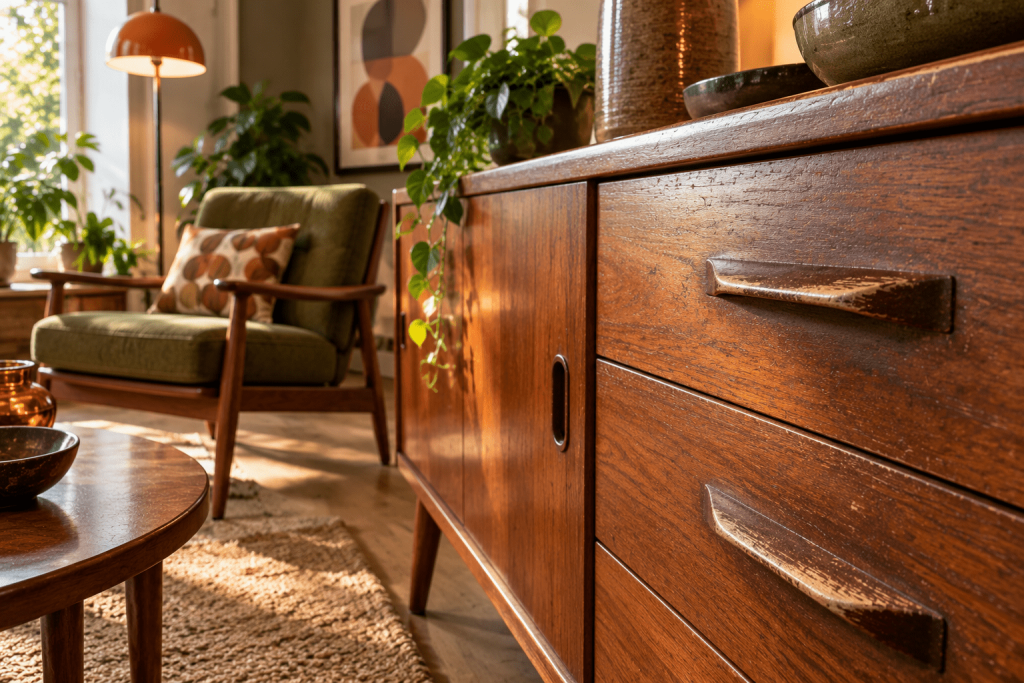
Vintage furniture can develop genuine patina too.
It simply hasn’t had as many decades to accumulate it as an antique.
Wood can darken.
Finishes can soften.
Edges can become worn.
Handles can develop areas of repeated contact.
Metal can oxidise.
Paint can fade.
Upholstery can show the marks of everyday use.
Look particularly at the places people naturally touch.
Drawer fronts.
Handles.
Armrests.
Table edges.
Chair seats.
Door pulls.
Corners.
The wear should make sense.
A piece that has supposedly spent sixty years in a family home should show some evidence of having actually been used.
But be careful.
Distressing has become a common decorative technique.
Furniture can be deliberately scratched, faded, chipped and aged to create a vintage appearance.
That is why patina should support your identification rather than determine it.
Vintage Does Not Mean Perfect
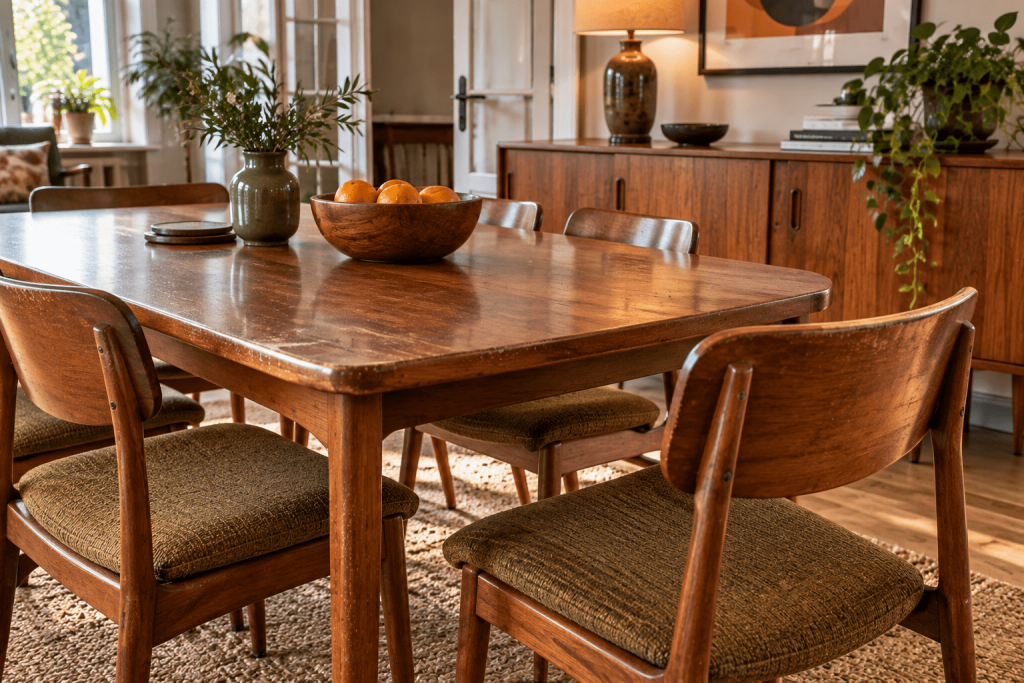
One of the pleasures of vintage furniture is that it often shows evidence of its working life.
A little wear isn’t necessarily a problem.
In fact, it can be part of what makes the piece appealing.
A dining table may have marks from decades of meals.
A desk may have worn edges where someone’s arms rested.
A chair may have softened wood around the arms.
A cabinet may have small scratches from being moved house several times.
These things can tell you that the object was actually used.
The question is whether the condition is acceptable and whether any damage or restoration has been properly understood.
Has It Been Restored?
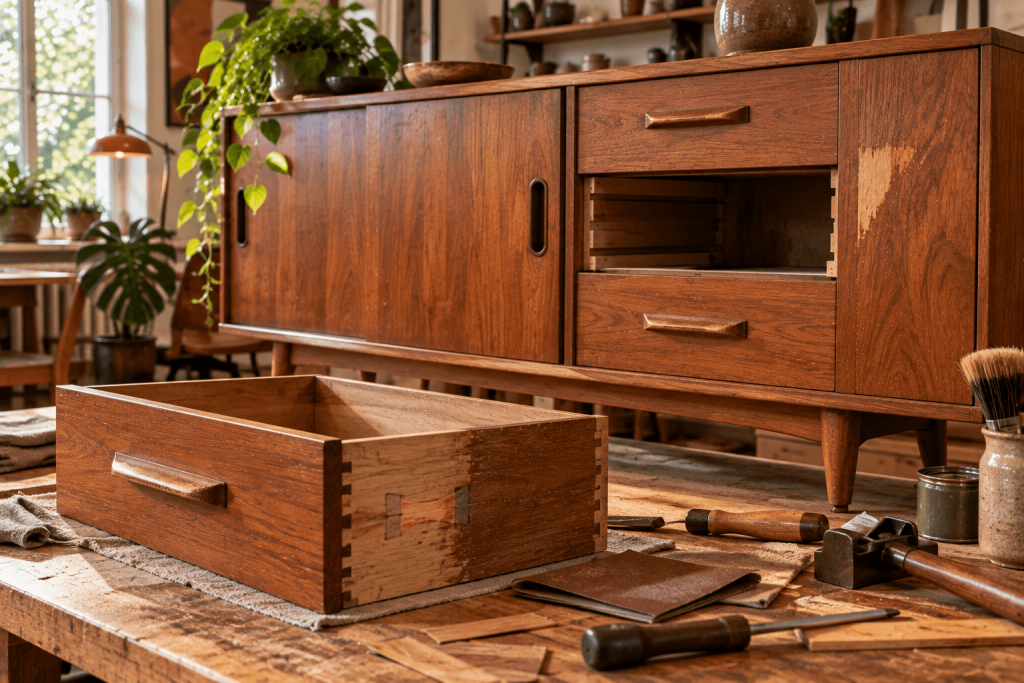
Vintage furniture can be restored, refinished, re-upholstered or modified.
Sometimes this is exactly what allows it to continue being useful.
A tired teak cabinet might be carefully refinished.
A chair might be professionally re-upholstered.
A damaged veneer might be repaired.
A missing handle might be replaced.
None of these things automatically make the furniture inauthentic.
But they can affect its originality and value.
Ask:
What is original?
What has been replaced?
What has been repaired?
Has the finish been changed?
Has the furniture been altered?
Those questions are often more useful than simply asking whether something is “original.”
Beware of Vintage-Style Furniture
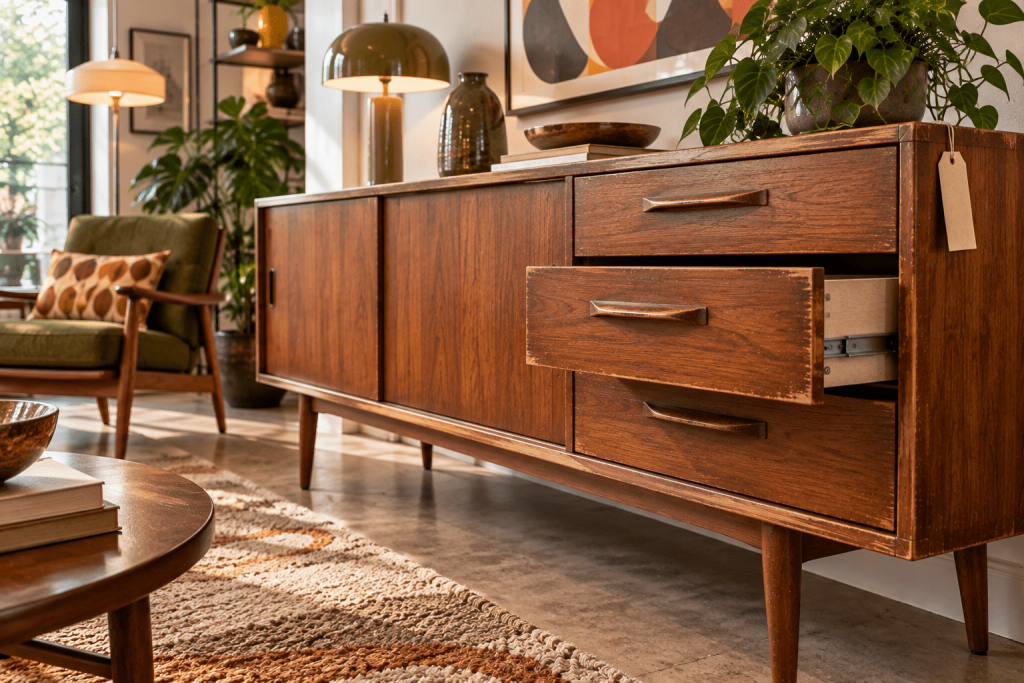
The popularity of vintage design means there is an enormous amount of furniture that is deliberately made to look vintage.
You will find new furniture described as:
- retro
- vintage style
- mid-century inspired
- industrial
- retro-inspired
- vintage look
- distressed
- reproduction
None of these terms necessarily mean the furniture is actually vintage.
This is where terminology matters.
A brand-new table inspired by a 1960s design may be beautifully made.
It may even be a better fit for your home than an original.
But it isn’t a 1960s table.
Don’t confuse design inspiration with age.
Vintage, Retro or Reproduction?
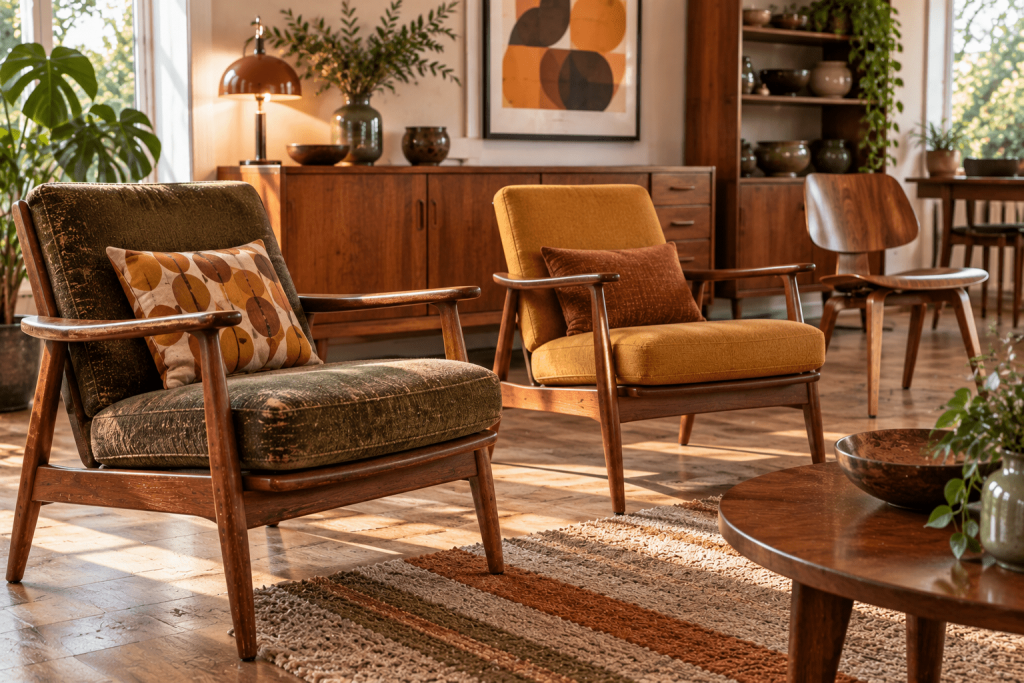
These terms are often used interchangeably, but they can mean quite different things.
Vintage generally refers to an older original object from a recognisable period, although the exact age range people use can vary. For example Etsy declares any item over 20 years old as vintage.
Retro usually describes something that looks back to an earlier period or deliberately uses an earlier visual style.
Reproduction means a newer piece made to reproduce an earlier design or type of furniture.
Revival refers to the return of an earlier style or design language.
There can be considerable overlap between these categories.
The important thing is to understand what you are actually buying.
Is Everything on the Piece the Same Age?
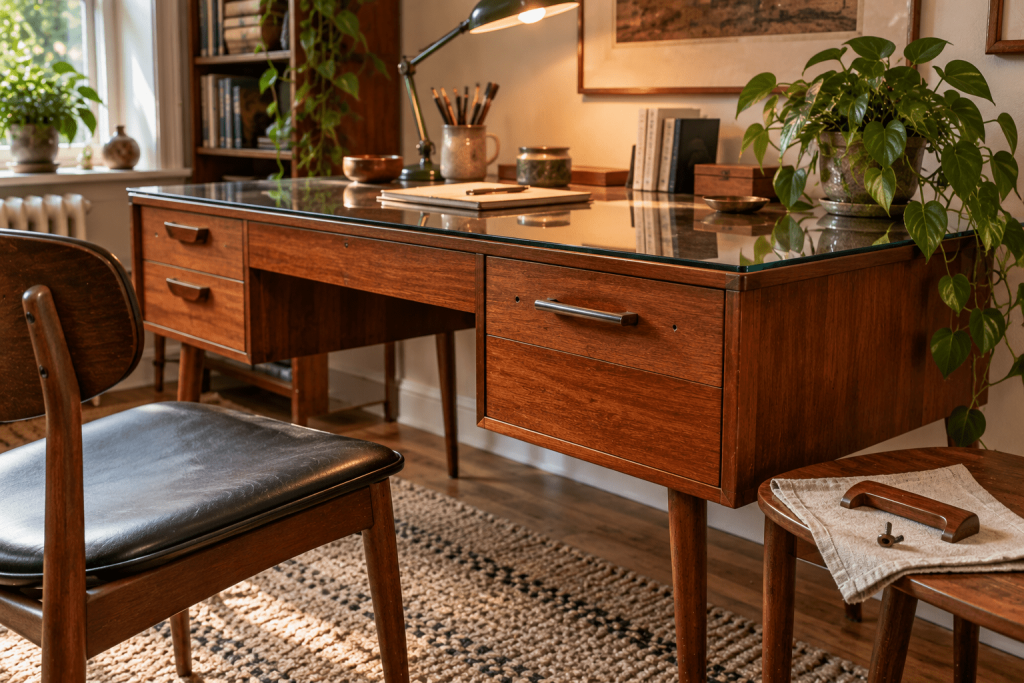
This question is just as important with vintage furniture as it is with antiques.
A cabinet may be older than its handles.
A chair may have an original frame but replacement upholstery.
A table may have had its top replaced.
A sideboard may have been modified to accommodate modern equipment.
A set of furniture may have been assembled from components from different periods.
This doesn’t necessarily make the furniture bad.
It simply means that its history is more complicated.
And complicated history can be fascinating.
Don’t Assume Mass-Produced Means Poor Quality
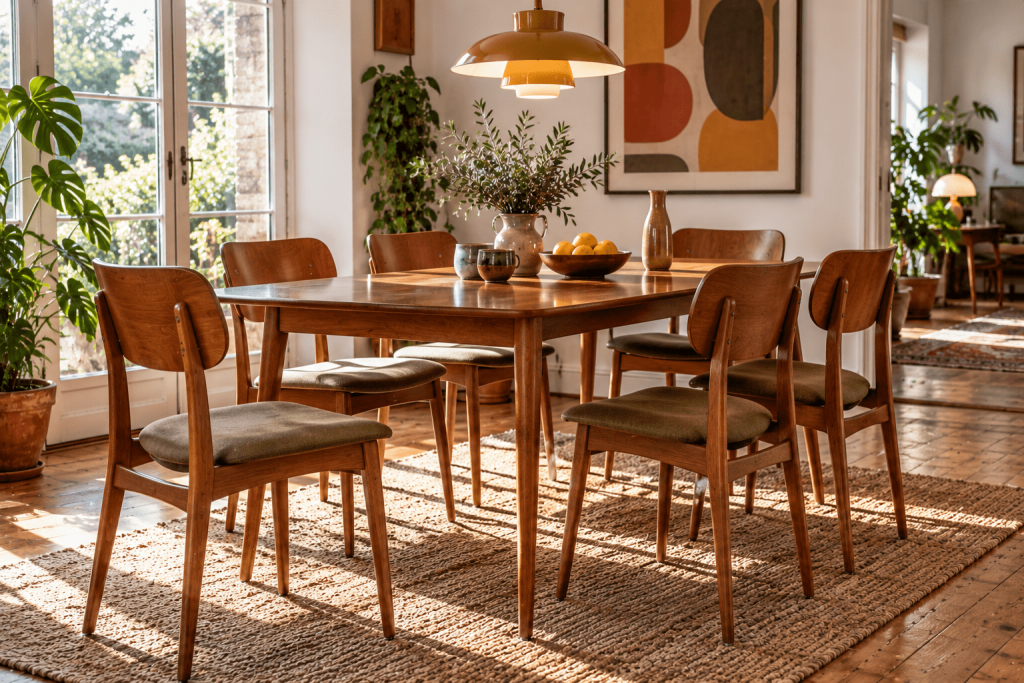
This is particularly important with twentieth-century furniture.
Some exceptional furniture was produced in factories.
Industrial production allowed manufacturers to produce well-designed furniture at prices that more people could afford.
Machinery could produce highly consistent components.
New materials opened up new possibilities.
Designers could work with manufacturers to create furniture that simply wouldn’t have been practical to make in the same way by hand.
So don’t dismiss something because it was factory-made.
Instead ask:
Was it well designed?
Was it well made?
Was it innovative?
Has it survived well?
Is it representative of its period?
Those questions can lead you somewhere much more interesting.
Look for the Details That Designers Cared About
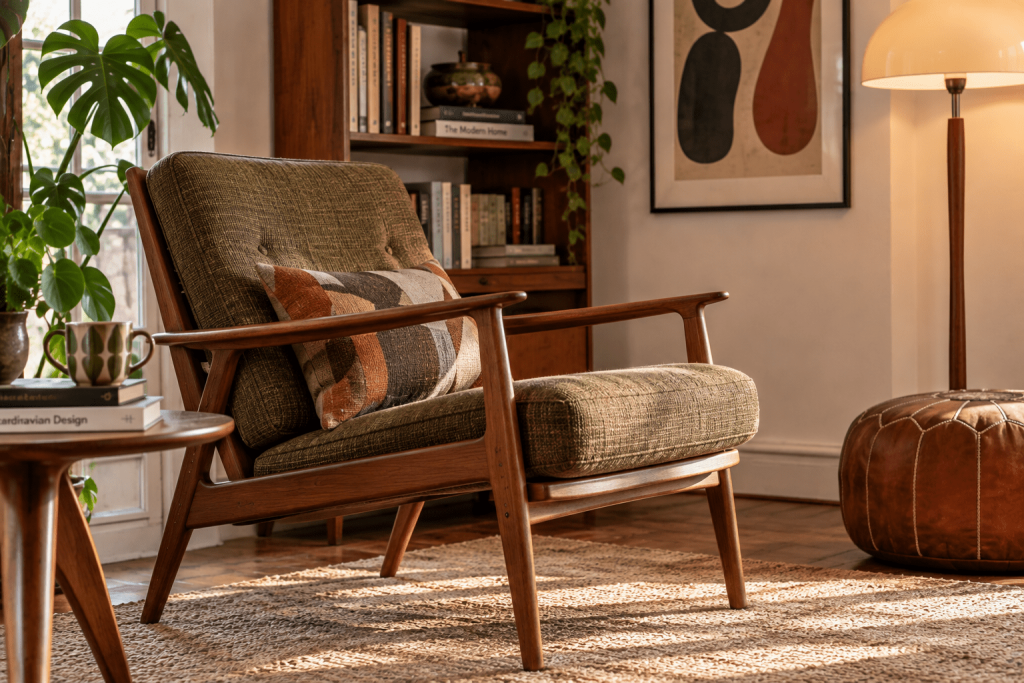
A good piece of vintage furniture often reveals its quality through details.
Look at the edge treatment.
Look at the grain matching.
Look at the way a handle sits.
Look at the join between materials.
Look at the underside.
Look at the feet.
Look at the back.
Look at the finish.
Look at how the designer dealt with practical problems.
Good design often makes functional decisions look effortless.
That can be one of the most enjoyable things to discover when examining vintage furniture.
So How Do You Actually Identify a Piece?
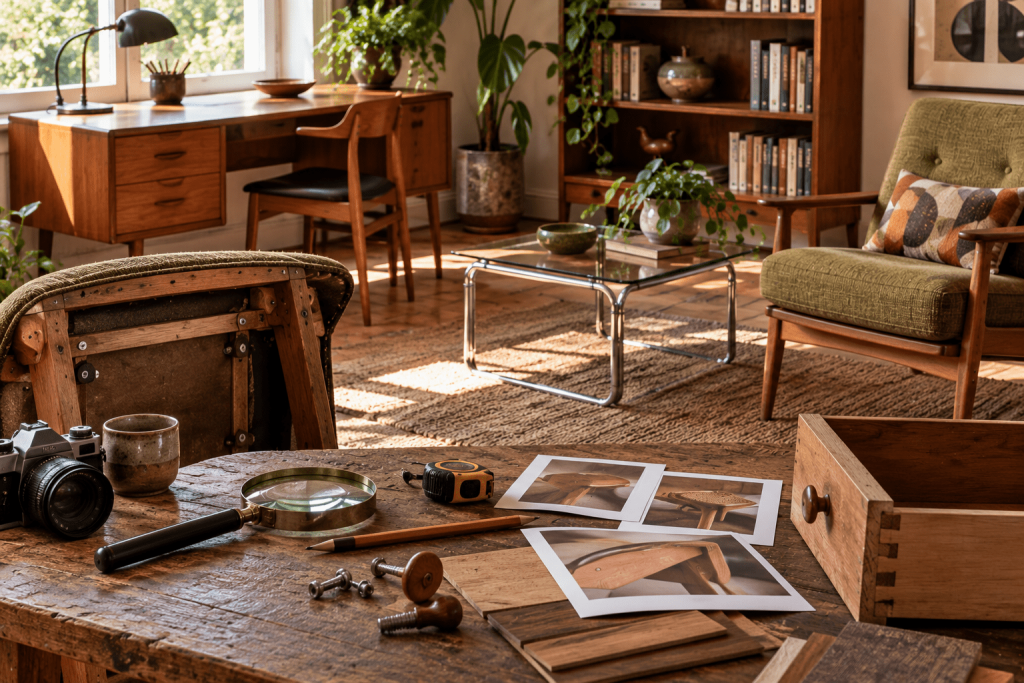
By now you may have noticed a pattern.
There isn’t one magical vintage-furniture detector.
Instead, you build a case.
Start with the overall design.
Then examine the materials.
Look at the construction.
Check the joinery.
Inspect the drawers.
Study the hardware.
Look for labels and marks.
Consider the country of origin.
Think about the style.
Look at the proportions.
Examine the wear.
Check for restoration and replacement parts.
Then ask whether all those clues agree.
If they do, you may have a convincing identification.
If they don’t, that’s when you investigate further.
What If You Still Can’t Identify It?
There is absolutely no shame in not knowing.
Vintage furniture covers an enormous amount of ground.
There are thousands of manufacturers, designers, retailers and regional styles.
Some pieces were produced in enormous numbers.
Others were made in relatively small quantities.
Some manufacturers disappeared decades ago.
Labels were removed.
Furniture was altered.
People moved house.
Pieces crossed borders.
Names were forgotten.
Sometimes the most honest answer is simply:
“I’m not sure yet.”
That’s not failure.
That’s the beginning of research.
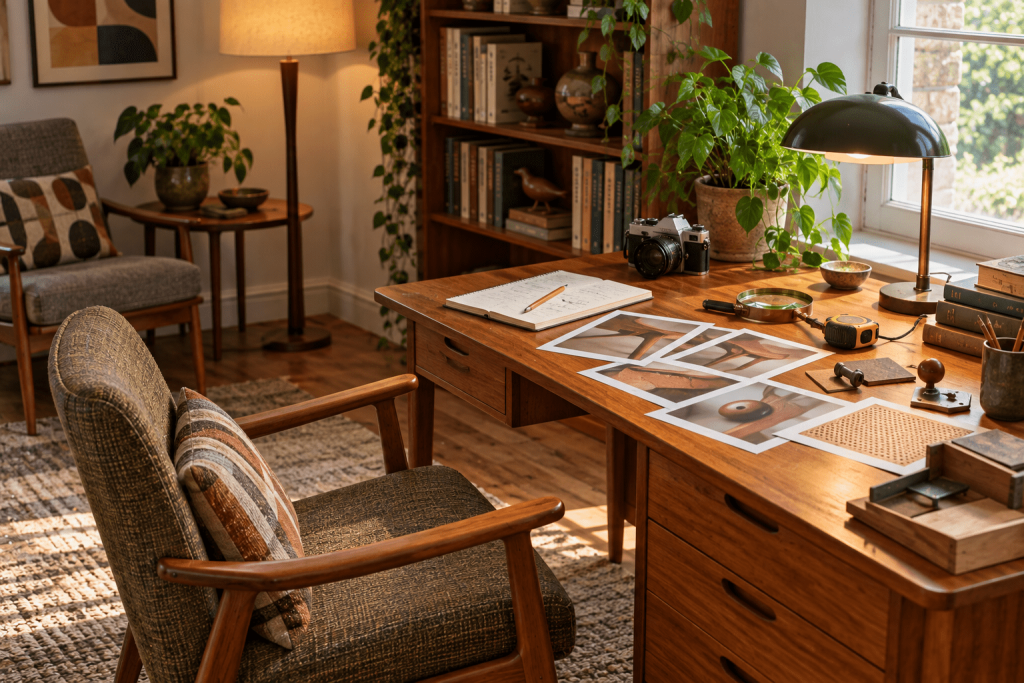
Take photographs from several angles.
Record the measurements.
Photograph labels, stamps, hardware and construction details.
Look underneath.
Search for comparable examples.
Check auction archives.
Consult books and specialist references.
Ask experienced dealers or collectors.
And if you’re buying something valuable, consider getting a specialist opinion.
A Simple EVE Vintage Furniture Identification Checklist
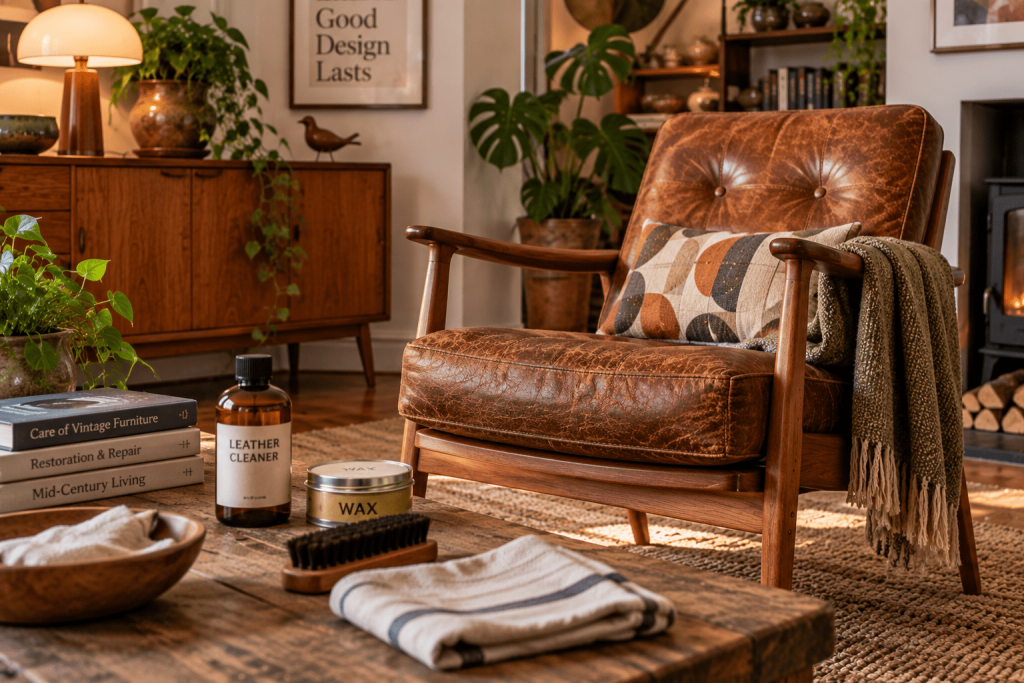
When you’re looking at an unfamiliar piece of vintage furniture, work through these questions:
1. What is it?
Identify the type of furniture.
2. What does the overall design suggest?
Look at shape, style and proportions.
3. What materials have been used?
Look at timber, veneer, plywood, laminate, metal, plastic, glass and upholstery.
4. How was it constructed?
Examine joints, fixings and the way components meet.
5. What do the drawers tell you?
Check their construction, bottoms, backs and runners.
6. What does the underside look like?
Turn it over if practical.
7. What does the hardware tell you?
Handles, hinges, screws and catches may reveal changes or repairs.
8. Are there labels or manufacturer’s marks?
Check backs, undersides, drawers and interiors.
9. Does the style fit the proposed period?
Don’t rely on appearance alone.
10. Does the wear look genuine?
Look for natural areas of use.
11. Has anything been replaced or restored?
Separate the age of the furniture from the age of individual components.
12. Do all the clues tell the same story?
This is the big one.
If they do, you’re probably getting somewhere.
The EVE View
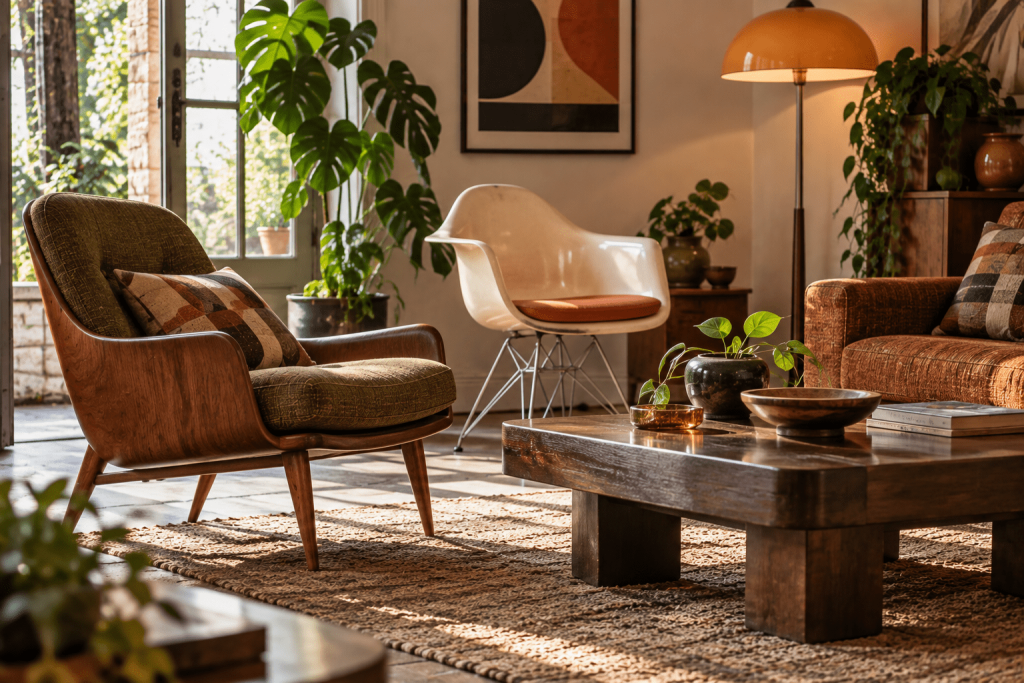
We think one of the nicest things about vintage furniture is that you can sometimes feel the period it came from.
Not because it has a magic date stamped on it.
Not because someone has written “1964” underneath in enormous letters.
But because the materials, design, construction and details begin to make sense together.
You start recognising the way a particular decade approached furniture.
You notice how manufacturing changed.
You begin spotting certain materials.
You start recognising shapes.
And eventually you walk past a piece and think:
“Hang on. I’ve seen something like that before.”
That’s when you’re learning.
You don’t need to memorise every designer.
You don’t need to become an expert overnight.
Just keep looking.
Open the drawers.
Turn the piece over.
Look underneath.
Ask questions.
And don’t be afraid to be wrong.
That’s how you get better.
Where To Go Next
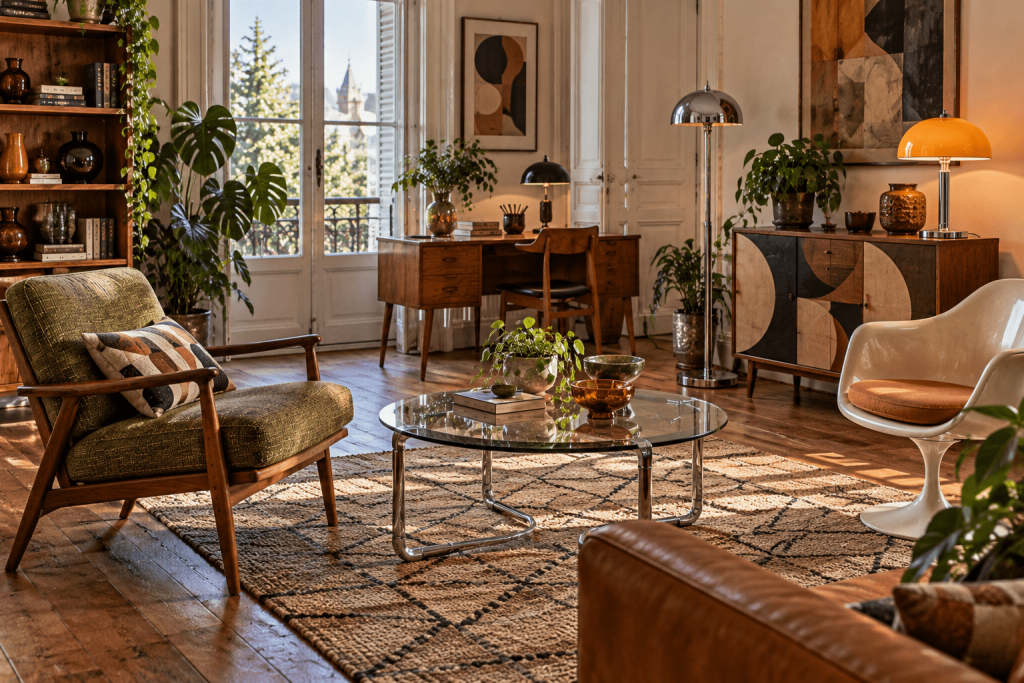
Once you start looking at vintage furniture this way, an entire world opens up.
You can start exploring individual decades.
1950s furniture.
1960s furniture.
1970s furniture.
1980s furniture.
Mid-century modern.
French vintage.
Scandinavian design.
Industrial furniture.
Vintage office furniture.
Vintage kitchen furniture.
And eventually, individual designers and manufacturers.
The next step isn’t necessarily to learn everything.
It’s simply to look at more furniture.
The more examples you see, the more familiar the patterns become.
And before long, something that once looked like “an old table” starts looking like a particular design, from a particular period, made using a particular set of materials and techniques.
That’s when vintage furniture really starts to come alive.
And, as we’ve discovered with antiques, there is always another drawer to open.